Performance Showdown: Apple M1, AMD Renoir, and Intel Tiger Lake CPUs Compared
Key Takeaways
- Apple M1 chip leads in both CPU and GPU performance for thin-and-light laptops
- Intel Tiger Lake offers competitive single-core speeds and strong Iris Xe graphics
- AMD Renoir provides solid CPU performance but disappointing graphics compared to rivals
- M1 shows exceptional power efficiency and overall system responsiveness
- Intel claims of 4.5x better graphics performance hold some validity in testing
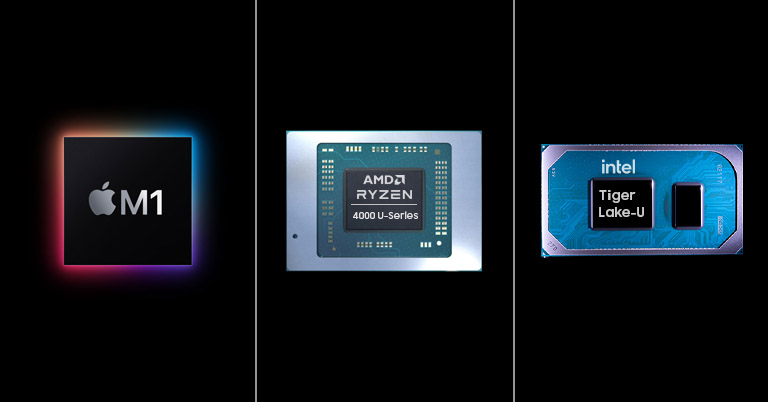
In the world of thin-and-light laptops, portability often comes at the cost of raw processing power. However, modern ultraportables are closing the gap, with each new processor iteration bringing significant improvements. This article compares three major CPU architectures shaping the ultraportable landscape: Apple's M1, AMD's Renoir, and Intel's Tiger Lake.
Apple recently made a bold move by transitioning away from Intel's x86 processors to its own Arm-based M1 chip. This shift has paid off handsomely, with the M1-powered MacBook Air, MacBook Pro, and Mac mini flying off shelves and receiving widespread acclaim. The M1 features an 8-core CPU and 8-core GPU built on a sophisticated 5nm process.
AMD's Renoir processors, part of the Ryzen 4000 series, have also made waves in the x86 world. These chips, built on a 7nm process, established AMD as a major contender in computing, outperforming Intel's existing Coffee Lake CPU lineup in independent benchmarks.
Intel responded with its 11th-gen Tiger Lake-U processors, based on the Willow Cove microarchitecture but still using a 10nm process. Despite this, Intel claimed these chips represent the "world's best processor for thin and light laptops."
To determine which CPU truly deserves the crown, we benchmarked three representative devices: a MacBook Pro 13" (M1), an MSI Modern 14 B4MW (Ryzen 7 4700U), and an MSI Summit E15 A11SCS (Core i7-1185G7).
In Cinebench R23 testing, the M1 dominated in both single-core and multi-core performance, scoring 1520 and 7792 respectively, compared to the Ryzen 7 4700U's 1200 and 7048, and the Core i7-1185G7's 1474 and 5312. This demonstrates Apple's advantage in handling both everyday tasks and demanding workloads.
Geekbench 5 results told a similar story, with the M1 achieving a single-core score of 1739 and multi-core score of 7642, outperforming both competitors. However, in GPU-focused tests, Intel's Iris Xe graphics surprised by outperforming AMD's Radeon graphics, though the M1 still led the pack.
Unigine benchmarks confirmed the M1's superior GPU capabilities, with significantly higher frame rates and scores compared to both Intel and AMD. GFXBench testing painted the same picture, with the M1 delivering exceptional graphics performance across various demanding scenarios.
In conclusion, Apple's M1 chip currently holds the performance crown for thin-and-light laptops, excelling in both CPU and GPU tasks. AMD's upcoming Cezanne processors may challenge this dominance in CPU performance, but the lack of corresponding graphics improvements leaves users wanting more. Intel's Tiger Lake offers competitive single-core speeds and surprisingly strong integrated graphics, making it a solid choice for users prioritizing graphics performance within the Windows ecosystem.