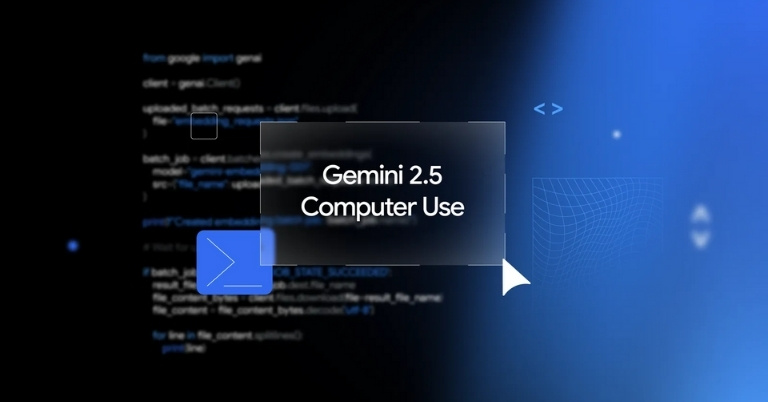
Google Unveils Gemini 2.5 Computer Use: An AI Model Designed for Human-like Web Interaction
Key Takeaways
- Gemini 2.5 Computer Use enables AI to interact with web browsers through 13 distinct actions, mimicking human behavior
- The model achieved over 65% accuracy in web and mobile task benchmarks with latency under 225 milliseconds
- Users must weigh workflow benefits against risks of data exposure and potential manipulation by malicious websites
Google has launched the Gemini 2.5 Computer Use model, a groundbreaking AI system designed to interact with computers in a manner resembling human users. Building on the capabilities of Gemini 2.5 Pro, this model operates through a continuous loop that processes user requests, analyzes screen captures, and executes actions such as clicks, text entry, and scrolling—all without depending on structured application programming interfaces.
The model functions by receiving a user request alongside a current screenshot of the interface. It then evaluates the request, decides on appropriate actions (like clicking specific coordinates or entering text), verifies the safety of each action, and carries out the operation within the browser environment. After execution, a new screenshot is captured and sent back to the model for further analysis, repeating the cycle until the task is complete or an error occurs. Google has also released a demonstration video showcasing the model organizing sticky notes.
In performance tests, Gemini 2.5 Computer Use demonstrated strong results, achieving over 65% accuracy in web-based tasks and mobile scenarios while maintaining latency below 225 milliseconds—significantly faster than competing models such as Claude Sonnet 4.5, which averaged around 280 milliseconds. This speed and precision make it a powerful tool for automating repetitive digital workflows and enhancing personal assistant capabilities.
However, the model does present notable challenges. Each use requires sending screenshots, URLs, and action histories to Google’s servers, potentially exposing sensitive personal information if the task involves confidential data. Additionally, malicious websites could exploit the system by displaying deceptive interface elements, possibly leading to unintended downloads or data leaks. Although Google’s model includes safety checks, users should remain cautious when deploying it for tasks involving private details.
For those interested in experimenting with Gemini 2.5 Computer Use, the model is currently accessible through Google AI Studio, with additional demonstrations available via Browserbase. As AI continues to evolve, this release marks a significant step toward more autonomous and intuitive digital assistance, offering both exciting opportunities and important considerations for safety and privacy-aware usage.