2025 Nobel Prize in Physics Awarded for Quantum Circuit Breakthrough
Key Takeaways
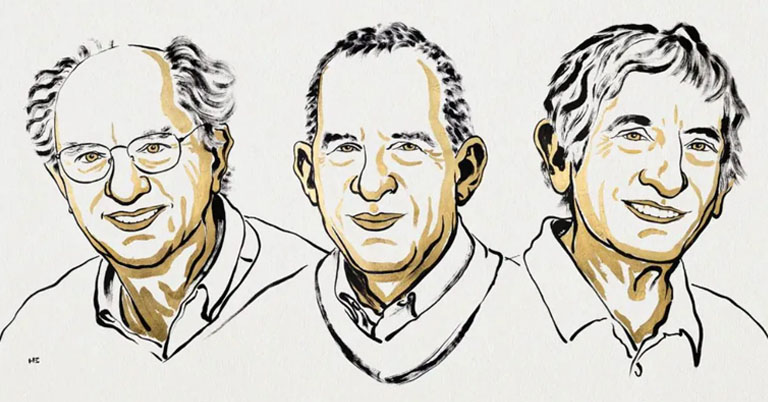
- John Clarke, Michel H. Devoret, and John M. Martinis win the 2025 Nobel Prize in Physics
- They demonstrated quantum tunneling and energy quantization in macroscopic circuits
- Their research underpins modern quantum computing and sensing technologies
2025 Nobel Prize in Physics Recognizes Quantum Circuit Discovery
Three scientists have been honored with the 2025 Nobel Prize in Physics for revealing that quantum phenomena can occur in large-scale circuits, overturning earlier assumptions that such effects were limited to microscopic particles.
John Clarke of the University of California, Berkeley, Michel H. Devoret of Yale University, and John M. Martinis of the University of California, Santa Barbara received the award "for the discovery of macroscopic quantum mechanical tunnelling and energy quantisation in an electric circuit."
In the early 1980s, the team conducted experiments addressing a fundamental question: how large can a system be while still exhibiting quantum behavior? At the time, most physicists believed quantum effects vanished when large numbers of particles were involved. The laureates proved this wrong, showing that quantum mechanics operates at larger scales under specific conditions.
Their research uncovered two key phenomena. First, they observed quantum tunneling at a macroscopic level. In their experiments, a circuit containing trillions of electrons demonstrated tunneling behavior, similar to a particle passing through a barrier without surmounting it. The electrons in the superconducting circuit acted collectively like a single giant particle, tunneling through a Josephson junction and generating a measurable voltage.
Secondly, when the circuit was exposed to microwave radiation, it absorbed and emitted energy in discrete amounts, a trait usually associated with atoms and molecules. This quantized energy behavior allowed the circuit to function as an "artificial atom," bridging the gap between manipulable macroscopic systems and quantum properties.
The implications of this work extend significantly into technology. Superconducting circuits have become a cornerstone for building quantum computers, with each qubit acting as an artificial atom containing Josephson junctions. The findings also laid essential groundwork for quantum cryptography and advanced quantum sensors.
Alongside the prestigious recognition, the three scientists will share the 11 million Swedish kronor prize, equivalent to approximately £871,400.
Article Last updated: October 13, 2025