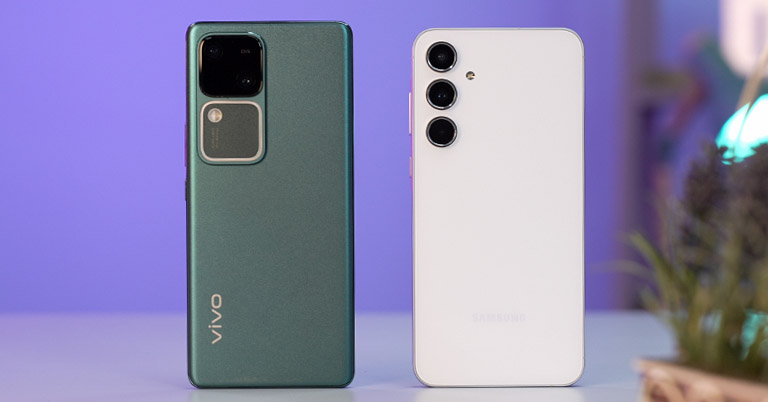
Vivo V30 versus Samsung Galaxy A55: Which Mid-Range Phone Wins?
Key Takeaways
- Vivo V30 priced at NPR 60,999; Samsung Galaxy A55 starts at NPR 62,999
- V30 offers faster 80W charging and vibrant camera processing, while A55 provides natural images and better software support
- A55 excels in design durability and software experience, but lags in gaming performance
The Vivo V30 and Samsung Galaxy A55 are both strong contenders in the mid-range smartphone market, each bringing unique features that appeal to different types of users. Here’s a detailed look at how these two devices stack up.
Cameras In daylight conditions, both phones produce detailed images with good dynamic range. The Vivo V30 tends to brighten scenes, lift exposure, and enhance shadows to create eye-catching photos, while the Samsung Galaxy A55 prefers a more natural look. For close-ups, the V30’s images show punchier contrast and warmer colors, often appearing more vibrant than the A55’s sometimes washed-out shots. The V30’s 50MP ultrawide camera clearly outperforms the A55’s 12MP version, offering more detail and better optimization. In low-light conditions, the V30’s darker contrast and warm color tone work well for night scenes, producing striking images, whereas the A55 maintains a more natural appearance. Both phones handle portraits differently: the A55 adds a slight pinkish hue to faces, while the V30 uses a contrasty yellow tone. The V30 also benefits from an autofocus feature for selfies, giving it an edge in self-camera performance. When it comes to video recording, the A55 supports 4K video on all lenses, including the ultrawide and selfie cameras, while the V30 cannot record 4K on its ultrawide lens. The A55 delivers smoother stabilization and more consistent footage, making it the better choice for video enthusiasts.
Design and Build The Vivo V30 features a curved design that feels comfortable in hand, though it lacks Gorilla Glass protection on the back and only offers IP54 dust and water resistance. In contrast, the Samsung Galaxy A55 has flat edges, IP67 dust and water resistance, and Gorilla Glass Victus Plus on the display, making it more durable. However, some users may find the A55’s sharp edges uncomfortable for long-term use.
Performance and Software For mobile gaming, the Galaxy A55 falls short due to insufficient optimization, despite its powerful Exynos 1480 chipset. The Vivo V30, with its Snapdragon 7 Gen 3 processor, handles casual gaming better but still isn’t a powerhouse. In terms of daily use, both phones perform well, but the A55’s One UI offers superior stability, usability, and customizability compared to Vivo’s Funtouch OS. The A55 also benefits from timely updates and longer software support, giving it an edge for long-term use.
Display The V30’s 6.78-inch AMOLED display is brighter, but the A55’s 6.6-inch screen excels in color consistency, HDR processing, and smooth 120Hz refresh rate performance.
Audio and Haptics The Galaxy A55 features stereo speakers with Dolby Atmos and sharper haptics, providing a richer audio experience compared to the V30’s single speaker setup. The lack of stereo speakers on the V30 is a notable drawback.
Battery and Charging Both phones offer around seven hours of screen time, but the V30 stands out with its 80W fast charging, included in the box, while the A55’s 25W charging feels slow for a premium mid-range device.
Conclusion If your budget is under NPR 61,000 and you prioritize vibrant camera output and fast charging, the Vivo V30 is an excellent choice. However, if you value long-term software support, a refined software experience, better multimedia performance, and durability, the Samsung Galaxy A55 is worth the extra cost. Gamers should steer clear of the A55 due to its current performance limitations.
Key specs
| Price | V30: NPR 60,999; A55: NPR 62,999 (8/256GB), NPR 67,999 (12/256GB) |
| Display | V30: 6.78-inch 120Hz AMOLED, HDR10+, 2800 nits peak brightness, 1.5K resolution; A55: 6.6-inch 120Hz AMOLED, HDR10+, 1600 nits peak brightness, FHD+ resolution |
| Storage | V30: 256GB UFS 2.2; A55: 256GB UFS 3.1 |
| Camera | V30: 50MP primary (OIS), 50MP ultrawide, 5MP macro; A55: 50MP primary (OIS), 12MP ultrawide |
| Battery | Both: 5000mAh; V30: 80W wired charging; A55: 25W wired charging |
| Processor | V30: Snapdragon 7 Gen 3 5G; A55: Exynos 1480 5G |
Want to compare this device with others?
Compare