MediaTek Debuts Powerhouse Dimensity 9500 Processor for Flagship Smartphones
Best deals in Nepal
Finding the best deals
Checking stores across Nepal for live prices.
Key Takeaways
- The Dimensity 9500 delivers 32% faster single-core and 17% faster multi-core performance over its predecessor
- It supports ray tracing, AI enhancements with NPU 990, and up to 200MP camera processing
- The chip integrates Wi-Fi 7, Bluetooth 6, and AI-powered network management for better connectivity
- Expected in devices like the OPPO Find X9 Pro and Vivo X300, launching globally in Q4 2025
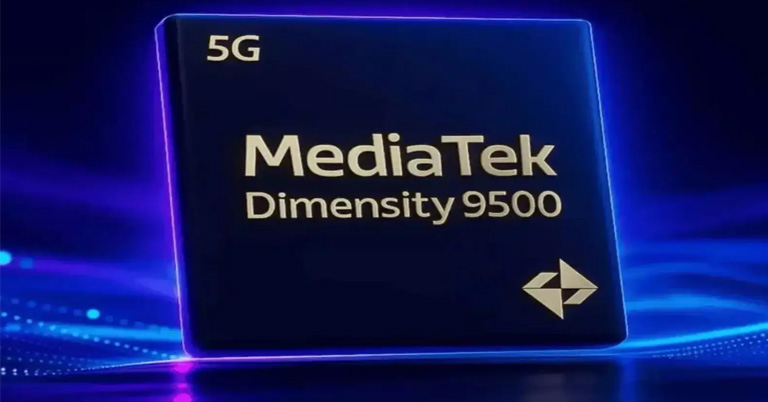
MediaTek has officially introduced the Dimensity 9500, the newest addition to its premium processor family, built to power the next generation of flagship smartphones. With a focus on performance, artificial intelligence, and power efficiency, the chip sets new standards for mobile computing.
At its core, the Dimensity 9500 features a third-generation “All Big Core” CPU architecture. This setup includes one C1-Ultra core running at 4.21GHz, three C1-Premium cores at 3.5GHz, and four C1-Pro cores at 2.7GHz. Compared to the Dimensity 9400, this configuration offers a 32% boost in single-core performance and a 17% improvement in multi-core performance. Notably, the ultra core consumes up to 55% less power during heavy workloads.
The processor also introduces SME2 support, enhancing AI processing capabilities. Tasks such as object detection now run 57% faster using half the power. While the NPU 990 remains the primary AI engine, SME2 provides additional support for models that are not specifically optimized for dedicated AI hardware.
In the graphics department, the Dimensity 9500 pairs with an Arm G1-Ultra GPU, delivering a 33% increase in peak performance and a 42% improvement in power efficiency over the previous model. MediaTek is pushing the boundaries of mobile gaming by incorporating ray tracing support, which sees performance gains of up to 119%, along with 120fps interpolation. The chip also supports Unreal Engine 5.5 and 5.6 features such as MegaLights and Nanite, enabling richer lighting effects and more detailed models in games.
For AI tasks, the NPU 990 doubles the compute power of its predecessor and adds BitNet 1.58-bit support, allowing for more efficient processing of large models. It can generate 3 billion parameter LLM outputs, handle texts up to 128K tokens, and produce 4K images while using up to 33% less power. A secondary Super Efficient NPU leverages compute-in-memory technology to run smaller AI models continuously with 42% lower power consumption, making it suitable for always-on AI applications.
On the imaging front, the Dimensity 9500 integrates MediaTek Imagiq 1190, capable of processing RAW images up to 200MP. It supports continuous focus tracking at 30 frames per second and 4K portrait video recording at 60 frames per second. MiraVision Adaptive Display adjusts contrast and color based on lighting conditions, panel properties, and content, improving visibility in both bright outdoor settings and dim indoor environments. Devices such as the OPPO Find X9 Pro and Vivo X300 are expected to utilize these camera enhancements for advanced multi-frame processing and portrait video capture.
Connectivity options include an integrated LTE/5G modem supporting speeds up to 7.4Gbps, Wi-Fi 7, and Bluetooth 6. The chip features AI-driven network selection and congestion prediction, improving accuracy by 20% and reducing latency by 50%. MediaTek claims a 10% reduction in 5G power usage and a 20% decrease in Wi-Fi power consumption, potentially translating to longer battery life for users.
The Dimensity 9500 is manufactured using TSMC’s 3nm N3P process and supports LPDDR5X RAM running at 10,667Mbps and UFS 4.1 storage. It also offers 4K 120fps video recording with Dolby Vision support and electronic stabilization.
The Dimensity 9500 is set to debut in upcoming flagship devices such as the OPPO Find X9 Pro and Vivo X300, with a global release scheduled for the fourth quarter of 2025. Nepali consumers can expect these devices to arrive shortly after the international launch.
Key specs
| Process Node | TSMC 3nm N3P |
| Bluetooth | Bluetooth 6 |
| Wi Fi | Wi-Fi 7 |
| 5G / LTE | Integrated sub-6GHz and mmWave, max 7.4Gbps download |
| Network Enhancements | AI-powered network selection, congestion prediction, reduced latency |
| CPU | 1x C1-Ultra @ 4.21GHz, 3x C1-Premium @ 3.5GHz, 4x C1-Pro @ 2.7GHz |
Want to compare this device with others?
Compare